History
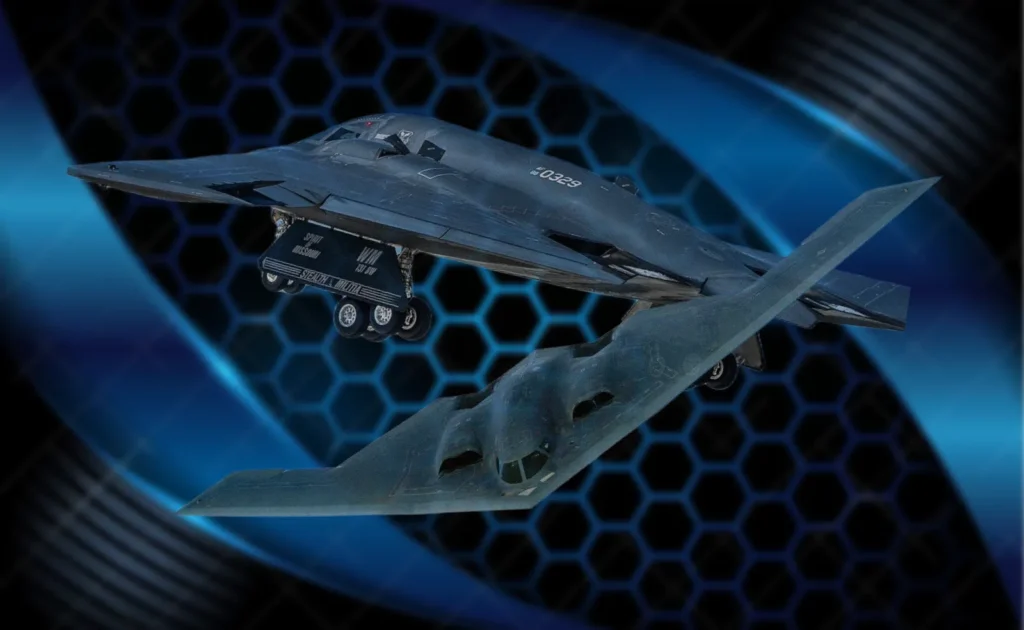
The Northrop B-2 Spirit is an American nuclear-capable subsonic stealth strategic bomber, often referred to as a “stealth bomber”,[A] solely operated by the United States Air Force.[5] A four-engined flying wing and lambda wing with a crew of two to three, it is designed with stealth technology to penetrate sophisticated air defenses.
The B-2 was designed by Northrop (later Northrop Grumman) as the prime contractor, with Boeing, Hughes Aircraft Company, and Vought as principal subcontractors. It was produced from 1988 to 2000.[6][1][7] The bomber can drop conventional and thermonuclear weapons,[8] such as up to eighty 500-pound class (230 kg) Mk 82 JDAM GPS-guided bombs, or sixteen 400 kiloton B61 nuclear bombs.[9] The B-2 is the only acknowledged in-service aircraft that can carry large air-to-surface standoff weapons in a stealth configuration.
Development began in 1979, as the Advanced Technology Bomber (ATB) black project during the Carter administration. Its promises contributed to cancelling the Mach 2-capable B-1A bomber, but development difficulties delayed progress and drove up costs. By 1996, the program produced 21 B-2s at a total cost of $44.7 billion (equivalent to $91.76 billion in 2025) or average cost of $2.13 billion (equivalent to $4.37 billion in 2025) per aircraft, including procurement, development, testing, and production.[10] The megaproject‘s considerable capital and operating costs made it controversial in the U.S. Congress, even before the end of the Cold War dramatically reduced the desire for a stealth aircraft to strike deep inside the Soviet Union; by the 1990s lawmakers shrank the planned purchase of 132 bombers to 21.
The B-2 has an estimated flight ceiling of 50,000 feet (15 km), an unrefueled range of more than 6,900 miles (11,000 km) and can fly more than 12,000 miles (19,000 km) with one midair refueling. It entered service in 1997, considered the second stealth aircraft, after the Lockheed F-117 Nighthawk. Primarily designed as a nuclear bomber, the B-2 was first used in combat to drop conventional ordnance in the Kosovo War in 1999. It was later used in Iraq, Afghanistan, Libya, Yemen, the 2025 strikes on Iran and the 2026 Iran war.[8][11][12] Based out of Whiteman AFB, Missouri, climate-controlled hangars have allowed the B-2 to forward deploy to NSF Diego Garcia in the Indian Ocean, Andersen AFB on Guam in the Pacific, and RAF Fairford in the United Kingdom.
The United States Air Force has nineteen B-2s in service as of 2024.[13] Another was destroyed in a 2008 crash,[14][15] and one was likely retired from service after being damaged in a crash in 2022.[13] The Air Force plans to operate the B-2s until 2032, as they are incrementally replaced by the Northrop Grumman B-21 Raider