History
The bicycle business of the Wright brothers, the Wright Cycle Company (originally the Wright Cycle Exchange) successively occupied six different locations in Dayton, Ohio. Orville and Wilbur Wright began their bicycle repair, rental and sales business in 1892, while continuing to operate a print shop (they ended their local newspaper business in 1890).[3] These shops helped them fund their aeronautical studies.
In 1896, they began manufacturing and selling bicycles of their own design, the Van Cleve, named after an early settler of Dayton, and the St. Clair, named after a territorial governor. They invented the self-oiling hub and devised the innovation of machining the crankarm and pedal on the left side with left-hand threads to prevent the pedal from coming unscrewed while cycling. The brick building at 22 South Williams St., where the Wrights worked from 1895 to 1897, is the only extant building on its original foundation and in its original location that housed a Wright bicycle shop. They ran their printing shop on the second-floor. The 22 South Williams Street building is part of Dayton Aviation Heritage National Historical Park and the National Aviation Heritage Area.[4]
The Wrights used the profits from the Wright Cycle Company to finance their aviation experiments.[3] In 1901, they fitted a third bicycle wheel horizontally above the front wheel of one of their St. Clair bicycles and used the apparatus as a test platform to study airfoil design. They built a six-foot wind tunnel on the second floor of their bicycle shop at 1127 West Third St., the last location of their bicycle business, and from October to December they conducted pioneering tests in the tunnel of over 200 shapes of scale-model wings.[3]
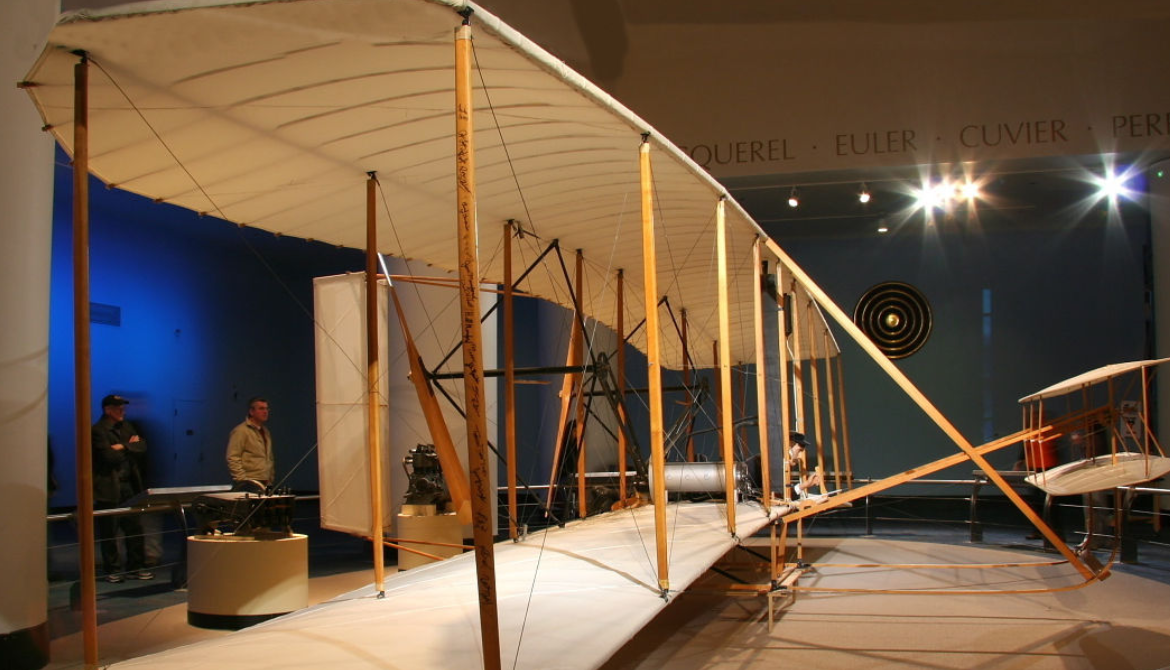
In that same building, they designed and constructed their gliders and first airplane, the Wright Flyer, which cost under $1,000 to build.[3] The shop closed in 1909 and they started their aviation company.[3] In 1937, with Orville’s cooperation, the building at 1127 West Third St. was moved to Greenfield Village, Dearborn, Michigan, by Henry Ford.